



HumanGO: Your Adaptive AI Coaching Platform
Welcome to HumanGO—your AI-powered path to smarter, more adaptable training.
Welcome to HumanGO, the AI-powered coaching platform designed to make your training more precise and fully personalized. Whether your goal is to crush a race, improve performance, or simply stay consistent, HumanGO adapts your training to your schedule, your goal, and your progress.
Over the next seven lessons, we’ll guide you through how HumanGO works—from connecting your devices and tracking your data to customizing your training week, setting goals, fine-tuning your workouts, and interacting with Hugo, your AI coach. By the end of this series, you’ll have all the tools you need to train with purpose, precision, and consistency.
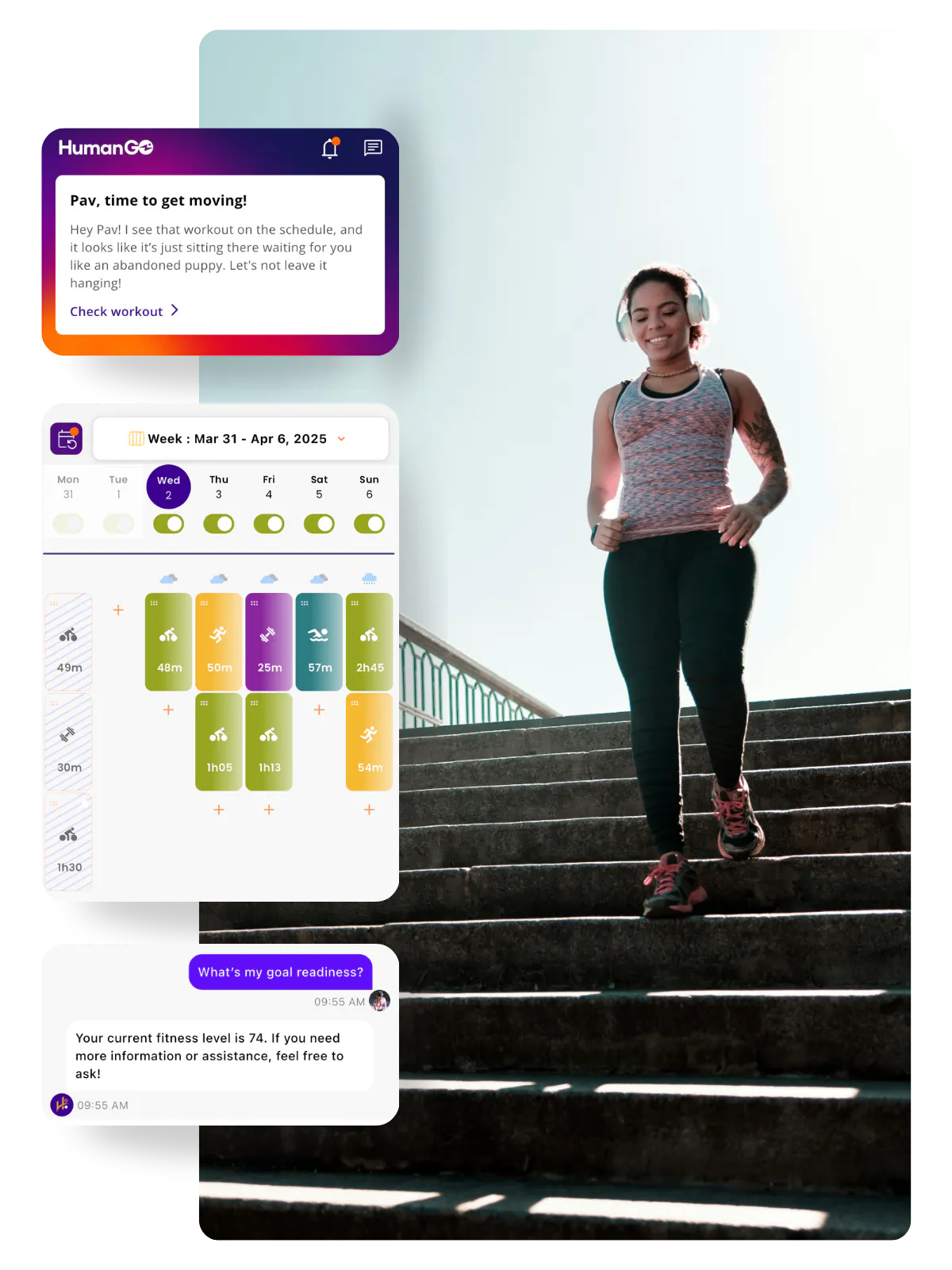
Jump Around
Lesson 1: The Power of HumanGO
Lesson 2: Navigating the App
Lesson 3: Make the Training Week Work for You
Lesson 4: Track Your Progress
Lesson 5: Setting and Editing Goals
Lesson 6: Testing and Fine-Tuning Training
Lesson 7: Meet Hugo
Resources
Lesson 1: The Power of HumanGO
You’ve already got discipline and experience. What you need now is precision.
Here’s how one athlete, Gian-Marcio, put it:
“Hugo adjusts my workouts in real time to match how I’m performing and feeling. It pushes me past what I thought possible, while keeping me from overtraining. I trust it to know when to go harder and when to pull back, and it’s made all the difference.”
That’s exactly what HumanGO does.
Hugo, your AI coach, builds your training week around your availability, goal(s), metrics, and progress, then adapts on the fly. Your training zones, periodization, and recovery are all optimized to keep you improving without tipping into burnout.
And just like training: what you put in is what you get out of it. Connect your devices, set your goals, check in daily, and log your sessions. Hugo uses that data to track your compliance, monitor your fatigue, and adjust your training so you’re building toward your goals with purpose.
First step: Connect your devices.
Second step: Log how you feel.
Both of these steps help Hugo learn from your workouts, detect fatigue, track your compliance, and make your plan to get you event-ready or help you progress toward your goals.
Lesson 2: Navigating the App
To get the most from HumanGO, it helps to know your way around the app. There are five main sections: Home, Plan, Social, Progress, and More.
1. Home Screen
Think of the Home Screen as your daily dashboard. It gives you quick access to workouts, check-ins, social feeds, and adjusting your training. You’ll see:
- Hugo’s Daily Insights — Workout reminders, recovery nudges, and training tips.
- Your Workouts — Today, tomorrow, and completed sessions, with the option to start them in the workout player or mark them as done.
- Subjective Check-Ins — Log how you’re feeling, which, combined with your wearable data, powers Hugo’s fatigue detection.
- Social Feed — See the latest activities and posts from your friends.
- Quick Actions Button — Replan your training week, log an injury/illness, or add a workout or goal right from here.
2. Plan Screen
The Plan Screen ensures your training stays aligned with your goals, life schedule, and current fitness. Think of it as your training and goal headquarters.
- View your training plan by day, week, or month by tapping the calendar dropdown.
- Set or edit goals by tapping the calendar dropdown, then Goals, or tapping the purple settings icon, then selecting “Add New Goal.”
- Drag and drop workouts to different days, reschedule missed sessions, or swap to a shorter/longer version.
- Configure your weekly training volume, availability, and long session days so Hugo adapts to your reality by tapping the purple settings icon and following the prompts.
3. Social Screen
Training for events can feel lonely, but it doesn’t have to. The Social Screen brings accountability, camaraderie, and fun into your fitness journey.
- Search for and join groups around specific sports, goals, or communities.
- Follow friends or teammates and cheer each other on.
- Share your training journey, swap motivation tips, and even create private groups for training buddies or clubs.
4. Progress Screen
The Progress Screen is where you track the big picture of your training. It shows that all the work you’re putting in is paying off, and where you might need to adjust.
- Aerobic & Metabolic – Tracks your endurance engine and how efficiently you use oxygen.
- Body Composition – Monitors weight, muscle, and body fat trends over time.
- Sleep – Shows how much and how well you’re recovering overnight.
- Health Metrics – Flags resting heart rate, heart rate variability, and stress to spot fatigue early.
- Goal Stats – Connects your daily training to your Goal readiness and projections.
- Activity Stats – Breaks down workouts and load so you see your progress stack up.
5. More Tab
This is your settings, integrations, and tools hub. The More tab is where you can fine-tune your training: Adjust Hugo, sync devices, configure sports, and get help with questions.
- Adjust Hugo’s coaching style (cheery, neutral, or drill sergeant).
- Enable automatic replanning if you want Hugo to adapt your schedule instantly.
- Connect wearables and apps (Garmin, Wahoo, Suunto, Apple Health, Zwift, etc.).
- Configure sports settings (select and deselect the sports you train).
- Explore the workout library, find a coach, or dive into the help center.
Lesson 3: Make the Training Week Work for You
You know training isn’t linear. Work, travel, fatigue, illness, and family life all get in the way. The question is how you adapt without derailing your progress.
That’s where HumanGO outperforms the rest. Within HumanGO, you have several ways to create a training schedule that works for you: make changes on the fly, edit your default training week (tied to your goal), create a customized training week (tied to a single week), and adjust for illness, injury, or recovery.
Let’s cover each separately, its purpose, and when to use each one.
Let’s cover each separately, its purpose, and when to use each one.
Default Training Week
Think of your Default Training Week as the foundation of your plan. When you set your main goal, Hugo automatically builds a balanced week of workouts based on your fitness level, available time, and the sports you’re training in.
You can edit your Default Training Week whenever your schedule changes, or whenever you want to adjust the number of sessions and duration of workouts in your regular training week.
When to use it:
Use your default training week when you want to set your standard training routine, such as the days you train, which sports you include, and how many hours you can commit each week.
For minor adjustments (like moving one workout or swapping a rest day):
- From the Plan Screen, drag and drop workouts to new days, toggle training days on/off, or tap a workout to modify or delete it.
- Hugo will remember your changes even after replanning.
How to adjust your default training week:
1. From the Plan Screen, tap the purple settings icon at the bottom right.
2. Tap “Edit Default Training Week.”
3. Tap the wizard wand icon to launch the setup wizard.
4. Follow the steps to:
- Set your maximum weekly training hours.
- Choose how many sessions per sport you’d like.
- Select which days you’re available to train.
5. Save your changes, and Hugo will automatically rebuild your plan to match.
Customized Training Week
A Customized Training Week lets you tweak multiple or individual weeks when your schedule shifts temporarily. Maybe you’re traveling, you want to focus on one sport, or have more time to train.
It’s perfect for when life doesn’t follow your default schedule. You can make changes to one week or apply changes across several weeks at once, without affecting your progress towards your goal.
When to use it:
Use this if your schedule temporarily changes. For example, if you’re on vacation, on a business trip, or have a rotating work schedule.
How to edit a customized training week:
- Go to the Plan Screen.
- Tap the purple calendar icon to the left of the calendar bar.
- Move, add, change, or delete workouts as needed, or tap the wizard wand icon to start the wizard.
How to edit several customized training weeks:
- Select “Customize Multiple Weeks.”
- Choose your goal from the dropdown menu.
- Select which weeks you want to adjust, then tap Next.
- Move, add, change, or delete workouts as needed or tap the wizard wand icon to start the wizard.
- Save your changes. (You can always reset back to default later.)
Tip: You can even name your customized week. This is helpful if you want to label it something like “Vacation Week” or “Base Build.”
Adjusting for Injury, Illness, or Recovery
When you log an injury, illness, or recovery period, HumanGO will automatically lower the intensity of your sessions or remove them from your schedule for that time frame. It doesn’t replace missed training, but it keeps your plan aligned with how you feel so you can return safely and steadily.
When to use it:
If you’re sick, injured, or simply need to rest more than usual, use this tool to let Hugo know that your training load should decrease.
How to make quick adjustments:
- From the Plan Screen, tap the purple settings icon.
- Tap “Add,” then select your condition (injury, sickness, or recovery).
- Set the duration and what level of training you can do during this period.
- Save your changes, and Hugo will adjust your plan accordingly.
You can use these tools whenever you need them, but it’s not required. Hugo constantly monitors your completed workouts and adjusts for you, so all you have to do is show up and exercise.
Lesson 4: Track Your Progress
Experienced athletes like you know: what gets measured gets managed. The Progress page is where you see the payoff.
Here’s what you’ll track:
1. Aerobic & Metabolic: Endurance and thresholds improving over time.
This shows how your endurance is building over time by tracking your max heart rate, pace, and threshold power. The better these numbers look, the easier it’ll be to hold a faster pace deep into your race.
2. Body Composition: Long-term trends in weight, muscle, and body fat.
This displays your weight, body fat, bone mass, and muscle mass (pulled from connected devices or manual entries). Use this to track trends, not day-to-day fluctuations (because everyone has those “fluid retention” days).
3. Sleep: Spot recovery patterns that support adaptation.
Poor sleep means slower recovery, which means a higher risk of burnout. Solid sleep is a free and totally legal performance-enhancing hack. This screen pulls in sleep duration and quality from your wearable. Use this to check for patterns and assess if you’re recovering enough to absorb training.
4. Health Metrics: HRV, RHR, and daily check-ins that show recovery status.
This screen includes key markers like resting heart rate, HRV (heart rate variability), and daily perception (don’t forget to mark how your workout went). Hugo uses these metrics to keep you from overtraining. Think of it as your “check engine light,” and if any of these start to creep in the wrong direction, it’s a signal your body might need extra rest.
5. Goal Stats: Compliance, current readiness, and projected race readiness.
This screen connects the dots between today’s workout and your goal or race day success. You’ll see your fitness chart, time planned and time spent in training zones, and your workout compliance. Use this information to measure your progress toward your peak performance.
Compliance = How often you’re staying within the prescribed zones in your sessions.
Current Readiness = How prepared you are today, as if the race were today.
Projected readiness = How prepared you will be on race day, assuming you follow your training plan.
6. Activity Stats: Total hours, distance, power/pace, efficiency, and peak performances.
Track your total activities, duration, distance, ascent, pace/power, and cardio efficiency. This section shows your activity metrics by heart rate decoupling and efficiency factor, your peak stats, and activity perception.
These aren’t just numbers. They’re feedback loops. The more data you add, the clearer the picture, the more precisely Hugo can adjust your training.
Lesson 5: Setting and Editing Goals
You’ve got your A race locked in, but the smartest athletes train with stepping stones. That’s where sub-goals come in.
Inside HumanGO, you can:
Add B and C races (“sub-goals”) that support your peak event.
Set multiple goals for the season (not just races).
Focus on development blocks: VO2max, increase threshold, or maintain your fitness.
How To Find Your Goals:
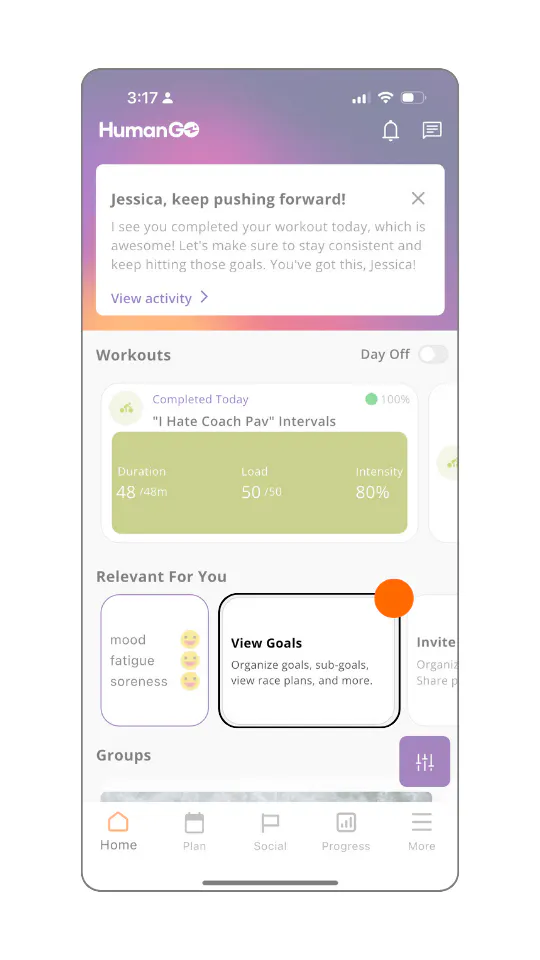
From The Home Screen: Tap ‘View Goals’ under ‘Relevant For You’
From The Plan Screen: Tap the calendar bar or tap the settings button in the bottom right corner, then tap ‘View Goals’.
How To Set New Goals
1. From the Plan screen, tap the settings button in the bottom right.
2. Tap Add, then Goal, then choose the type of goal:
- Participate In A Race: Train for a running, cycling, or triathlon event
- Select your sport, then the event.
- Enter the event name, race date, and location.
- Select your target: Finish The Race, Challenge Yourself, or Be Competitive.
- (Optional) Add custom finish time, taper, and recovery days.
- Challenge Yourself: Take on a hike, bike-packing trip, or century ride
- Select your sport, then the event.
- Set the goal specifications, then enter the goal name and its date.
- Pick target: Finish The Race, Challenge Yourself, or Be Competitive
- (Optional) Add taper and recovery days.
- Improve Performance: Target specific areas, such as endurance, VO₂ max, or threshold.
- Select a focus area.
- Name your goal and select your start date.
- Adjust plan duration and choose difficulty.
- Improve General Fitness: Improve your fitness, maintain your fitness, or lose weight
- Select an area to focus on.
- Name your goal and select your start date.
- Set duration and intensity level.
4. Tap Save to lock in your goal and generate your training plan.
How To Edit An Existing Goal
Edit Overview (Goal name, date, location)
- Tap Edit Goal.
- Tap the pencil icon to change the name, date, location, and target.
- Tap Done to save.
Edit Goal Phases (Training methodology)
- From the Goal Overview screen, tap Phases.
- Edit or Delete phases.
Note: This is a more advanced setting, so if you need help, watch Coach Pav’s walkthrough.
Edit Sub Goals (Supporting goals)
- From the Goal Overview screen, tap Sub Goals.
- Find your main goal, then tap Add Sub Goal.
Note: This is a more advanced setting, so if you need help, watch Coach Pav’s walkthrough.
Edit Race Plan (Predicted finish time, pacing)
- If your goal is a race or event, you can create a race plan to see your predicted finish time and a pacing plan to reach it)
- From the Goal Overview screen, tap Race Plan.
- Tap Generate Race Plan.
- Upload a .FIT file of the course (if you have one) and complete the empty fields.
- Tap Generate Plan.
And when you achieve a goal? Adjust and reset so momentum never stalls. Hugo recalibrates your training cycles automatically, ensuring every week ties back to your bigger picture.
Lesson 6: Testing and Fine-Tuning Training
HumanGO can use your workout data to update thresholds automatically, but if you want direct calibration, you can run specific tests:
Hugo Recalibration Test
The Hugo Recalibration Test is the gold standard fitness assessment that pros trust to deliver precise thresholds and training zones tailored to your performance. This test consists of three maximal-effort intervals in a single or 2-day session: 1-minute max effort, 3-minute max effort, and 12-minute max effort.
Threshold Tests
Threshold Ramp Test: Not an all-out effort, but instead, a ramp of efforts, recording the point when you can’t hold your power any longer. It can be easier to complete than a max all-out test.
Submax TPA Test: Not an all-out effort, but instead, a 15-minute effort recording the point when your breathing rate changes. It’s easier than a max all-out test.
Max HR Tests
20-minute maximum: This tests your average heart rate during a 20-minute max effort test.
4x2-minute maximum: This requires you to complete 4 x 2 minutes of maximum intensity efforts with only 1 minute rest in between.
6-minute maximum: This tests your average heart rate during one 6-minute maximum capacity effort.
How To Add A Test:
From the Plan Screen, tap the purple settings icon, then tap “Add.”
Tap “Performance Test.”
Select your sport: running or cycling.
Select a test: Hugo’s Recalibration, Threshold Test, or Max HR Test.
Select a date based on Hugo’s recommendation or select your own date.
Tap Confirm.
When completed, Hugo updates your training zones so every workout is precisely targeted. No guessing. Just data-backed, pro-level training that keeps you sharp.
Lesson 7: Meet Hugo
Hugo is your 24/7, 365-days-a-year coach inside the app. Multilingual and context-aware, Hugo can answer questions about your metrics, nutrition, hydration, and training goals.
Hugo has access to the Help Center and will answer your questions directly in the chat. Hugo will take into consideration useful information about you to generate the most adapted answer, like your age, gender, current phase, next goal, etc.
Hugo can read the calendar
Hugo has access to your training plan, and you can ask the following questions:
Race or goals
Workouts
Injury event, Sickness event, or Days off
Phases (base, taper, build, peak, recovery, adaptation)
If the list of events is too big, Hugo will list the first items and ask you if you want to know more.
Example:
"When is my next cycling workout?"
Hugo can read the metrics
You can ask Hugo to give the current value of the following metrics:
Fatigue (AWL)
Fitness (CWL)
Weight
Height
Body fat
Resting heart rate
Max heart rate for running, cycling, and swimming, and also the general value
Threshold power for running and cycling
Threshold pace for running and swimming
Example:
"fmanagWhat is my running threshold pace?"
Update the metrics
You can ask Hugo to modify the value of the following metrics:
Fatigue (AWL)
Fitness (CWL)
Weight
Height
Body fat
Resting heart rate
Max heart rate for running, cycling, and swimming, and also the general value
Threshold power for running and cycling
Threshold pace for running and swimming
Example:
“Set my weight to 70 Kg.”
“Update my running TPA to 5:30 (This will be understood as 5min 30sec per kilometer or per mile, depending on the athlete's measurement system (metric or imperial)).”
Schedule some days off
Hugo can modify your schedule to add some days off. You will be asked to give the list of dates you want off. You are asked to confirm, and a replan is launched to take the changes into account.
Example:
“I need days off until Friday.”
Launch a replan
You can replan your schedule for a period of time. You are asked to confirm.
Example:
“Replan from tomorrow until the end of the month.”
Manage fatigue
If you are feeling fatigued, Hugo will adjust your training accordingly by temporarily reducing your training load for a period of time. You can choose if you want to launch the replanner or not.
Example:
“I am feeling tired.”
Add a goal
First, Hugo asks for the category of the goal among:
Triathlon
Fitness
Running
Duathlon
Cycling
Swimrun
Aquathlon
Then you need to select the name of the corresponding goal and give a date. During the workflow, you can ask for additional information about each goal.
Example:
“Schedule a new goal please.”
Add an injury
You can report an injury to Hugo. At the beginning of the conversation, Hugo will say that if you want to edit the content of the scheduled workout (e.g., change the sports), you need to go to the Availability menu.
You can ask to keep the training or cancel the workouts, and you will need to give the day that you think you will resume your training. If you want to keep training, you will be asked if you want to reduce the intensity.
Example:
“I sprained my ankle and can't train anymore.”
Add a sickness
You can report an injury to Hugo. At the beginning of the conversation, Hugo will say that if you want to edHugo will first ask if the sickness is serious or mild. Hugo also explains that a mild illness means we can keep their training at low intensity, while a serious one means no training at all. Then, it will ask the date when you’d like to resume training.it the content of the scheduled workout (e.g., change the sports), you need to go to the Availability menu.
Example:
“I am sick.”
Add a test workout
Currently, Hugo can only schedule a test workout. It will first ask the category of test:
Threshold
Max heart rate
Hugo Recalibration Test
Then you will specify the sport and give a date. If relevant, Hugo will suggest a date for the test.
Example:
“Schedule a new test please.”
Hugo feedback
Hugo can give you feedback in certain places.
After you complete a workout, Hugo will analyze the data instantly and provide this feedback within the completed activity card. You can view this by opening the workout from the homescreen or plan screen.
Hugo can also provide you with feedback on a weekly or phase basis. The feedback you receive will vary, but it will summarize either the week or phase you have just completed.
To check your Hugo settings:
Click 'More' in the bottom menu on mobile or your name on the web.
Then click 'Settings' to open either Hugo settings or General settings.
Adjusting the Hugo settings will change your experience with Hugo. This varies, but you can select a different tone for Hugo to speak to you with, and whether you receive feedback at certain times in your training. You can also turn the Automatic replan on or off here.
What Hugo can't do
Here are some commonly asked questions to Hugo that, currently, Hugo cannot do:
- Change workout start times: For one individual workout, you can change this by tapping 'Edit workout' from the workout menu. To change your default workout start time, go to More > App Settings > General Settings > Enter default start time. You will need to replan your workouts in order to see the start time changes.
- Modify or delete a goal from the calendar: Go to Plan > Calendar dropdown menu > Goals > Tap three vertical dots next to Goal > Delete Goal, or tap goal to modify.
- Modify or delete a sickness, injury event, or days off event: Go to Plan > Tap purple settings icon > Tap 'View health & recovery' from the menu. Here you can see all your health & recovery events, including recovery as planned by Hugo. To edit, click the pencil icon, and to delete, click the trashcan icon.
- Modify or delete a workout from the calendar: Go to Plan > then long pressing the workout and dragging to the bottom on mobile, or on the web you can click the menu in the workout card, and then delete.
- Create a workout and add it to the library: Available only on the HumanGO web app, you can create a new workout by clicking '+ Create Workout'.
- Schedule a workout in the calendar: Go to Plan and then the '+' icon on the day you wish to add the workout to.
Resources
Facebook Community - Meet other HumanGO users
HumanGO Help Center - Find quick answers and help
Coach Q&A - Join a live session with our HumanGO coaches for a demo of the app
Message our customer support team - If you can’t find an answer between the Facebook Community, Coach Q&A, and FAQ Help Center, reach out to our Customer Support Team
